


11-15 Space Facts
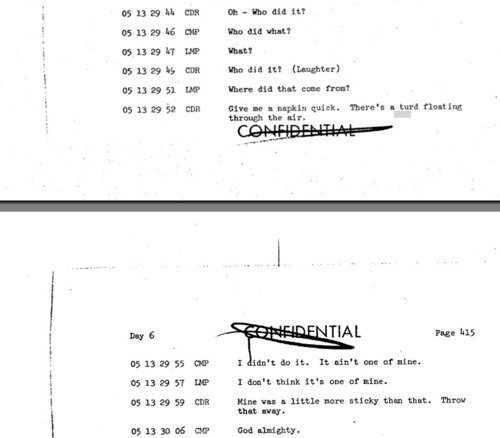
11. There was a mystery turd floating around in the Apollo 10 capsule. Here is the full document of that transcript, the poop incident is on page 416.
12. Space is realllllllllllllllllly big. So big we can only see 46.5 billion light-years before we hit the edge of what’s effectively a bubble that we’re trapped in. We’re trapped in it because the universe is accelerating faster than light itself can catch up, meaning that distant objects will gradually just hit the edge of the bubble – the edge of the observable universe – and poof no longer exist for us.
In 5 billion years, the expansion of the universe will have progressed to the point where all other galaxies will have receded beyond detection. Indeed, they will be receding faster than the speed of light, so detection will be impossible. Future civilizations will discover science and all its laws, and never know about other galaxies or the cosmic background radiation. They will inevitably come to the wrong conclusion about the universe. We live in a special time, the only time, where we can observationally verify that we live in a special time.
13. Our Sun converts mass to energy. It loses the equivalent of fifty-seven Titanics EVERY SECOND. It’s been doing that for 4.7 billion years. In that time, it has burned about the mass of the entire Earth one hundred times over. It’s about halfway through its lifespan. If it were to continue burning fifty-seven Titanics every second for 10 billion years, then at the end of that period it would have used up less than one tenth of one percent of its total mass. Space is fu*king massive.
14. I have got some facts:
· If our Sun disappeared out of existence, you wouldn’t realize it for 8 minutes.
· You can fit every planet, right next to each other, in the distance between the earth and the moon! With room to spare!
· How empty it is. If we took 3 grains of sand and placed them inside a vast cathedral, that cathedral will be more filled with sand than the universe is with stars. There’s an average of 1 atom per meter cube in the universe.
· Every single atom in the universe has a gravitational pull on you and vice versa. From a single iron atom in the earth’s core to a black hole millions of light-years away, it’s all pulling on you.
· Everything in our galaxy is orbiting around a supermassive black hole.
· Fifty trillion solar neutrinos pass through your body every second.
· We live in a very unique time when we can deduce the future of the universe and we can also see what happened in the past.
15. Turtles were sent into space by the Soviet Union in 1968. They launched a probe with turtles on it to study how it affected the animals.
The two brave Russian Tortoises were among the first animals to leave low earth orbit and enter space around the moon. This mission, called the Zond 5 mission, happened in September of 1968, 3 months before Apollo 8.
They splashed down safely in the ocean, where they were rescued and found to be in good health.
16-20 Space Facts
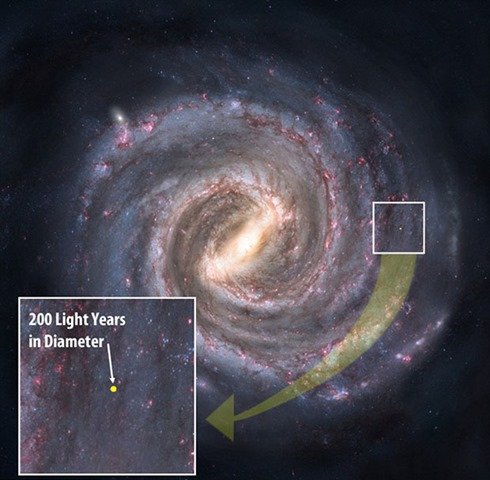
16. Humans have been creating radio signals for about 100 years. These signals move at the speed of light (since they are light). That means that our radio broadcasts have traveled about 100 light years away from earth. The above image is a rendering of our galaxy showing how far our radio has gone.
17. Two facts about photons.
a. If you look up and see a star, a photon generated by the core of that star has just spent dozens of years travelling through space just to hit your retina.
b. Special relativity tells us that the faster you travel, the slower time passes for you. For a photon, travelling at the speed of light, time stops entirely. So take a photon from the Cosmic Background Radiation, from our perspective it has been around almost as long as the history of the universe. But from it’s perspective, literally zero time has passed since it was emitted.
18. We now know how common planets are around other stars. For a time we could only detect gas giants, but now we are starting to find Earth-sized planets orbiting other stars in the habitable zone. We’ve detected thousands of exoplanets, even using the decrepit Kepler telescope which is on its last legs. When the James Webb Space Telescope is in operation in 2018, we will be able to take direct photographs of planets orbiting other stars. We can then analyze these photos to detect atmosphere, and signs of life. It will be a very exciting time.
19. Slightly morbid and weird, but the inevitable heat death of the universe. As a result of entropy, everything will get slower and slower until every atom, and sub-atomic particle stops moving, and everything is at 0 Kelvin. I find this concept weirdly peaceful.
20. It only takes going to the 39th digit in pi to calculate the circumference of the observable universe to the width of a single hydrogen atom, yet we’ve calculated pi to over two trillion digits.