


21-25 Space Facts
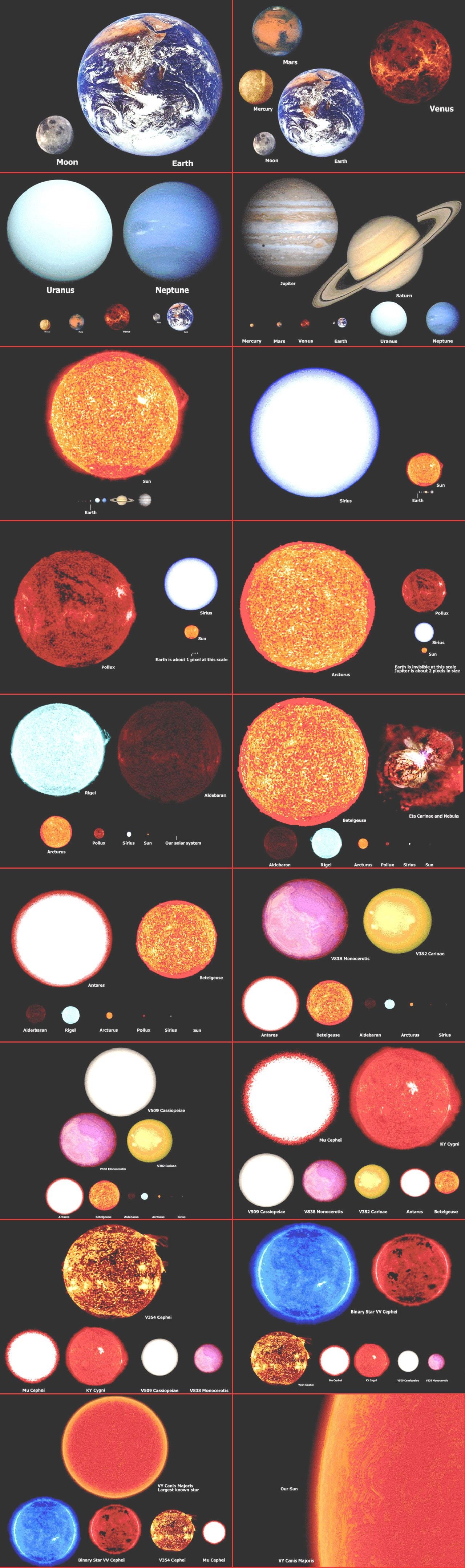
21. The size of Earth compared to other planets and the sun and then how small the sun is compared to other stars. It’s beyond my mind.
22. Hold up your hands and clap them together. Wait one second, then do it again. If you could plot the distance between the first clap and the second clap, it would be more than 800 kilometers. This is because the Earth is moving around the sun, the sun is moving around the center of the galaxy, the galaxy is moving through the Virgo Supercluster, and the Virgo Supercluster is barreling through the universe. When you add up all the velocities and compare the result to the cosmic microwave background (which is the closest thing we have to a universal frame of reference), it comes out to about 800 kilometers per second. In the time it took you to read this, you’ve traveled farther than you’ll ever walk in your life.
23. Black Holes are the coolest and simultaneously scariest things in existence. Once you pass the event horizon you have never been more trapped. I’m not sure there are ways to have a more certain death than that, because at that point, not even LIGHT can escape. Ever thought about why they’re so big and black? Well they’re not, they’re tiny, but they are so ridiculously huge and dark because that is when light can no longer escape the singularity and that just creates an empty void that is huge.
You think that’s crazy? The time dilation around black holes is MASSIVE. For every few days you spent orbiting a black hole something like 30 years could pass by on Earth. We’re still not done. Once you actually pass the event horizon, time stops. No, it’s doesn’t go very slowly. It. Stops. Relative to you, that is. To an outside observer it would seem as if you are not moving at all, and then they would see you slowly fading.
24. Look at your wrist, see the blueish veins? The blood flowing through them contains hemoglobin, a protein that has four iron atoms incorporated into its structure. Iron is only naturally produced in one place, it can only be forged in the core of dying stars. Every time you look at your veins, remember that you are built from, and kept alive by, pieces of stardust.
Stars are powered by nuclear fusion, taking light elements and fusing them to produce heavier ones. This process converts hydrogen to helium to lithium and so on. Each act of fusion releases energy which helps sustain the star. However, when the star reaches the end of its life, it begins to fuse atoms together to produce iron. The fusion reaction to produce iron is the first to consume energy, thus destabilizing the star’s delicate balance between radiation pressure out and gravity in.
Suddenly, gravity gains the upper hand and the star begins to collapse resulting in a supernova destroying the star, scattering its remnants through space where they may later coalesce into planets that now have the required atoms for life to arise.
25. It took humans about 10,000 years to go from the beginnings of agriculture to space travel. It will be 4 times that long (40,000 years) before Voyager comes close to another solar system.