


The Hanging Gardens of Babylon are among the most famous wonders of the ancient world. According to ancient writers, the gardens were an enormous collection of trees, flowers, and plants built on massive terraces in the city of Babylon. Some descriptions make them sound almost impossible, with gardens apparently rising several stories into the air and being watered using an ingenious irrigation system.
However, there is one major problem: archaeologists have never found convincing evidence that the gardens actually existed in Babylon. So, were the Hanging Gardens real, or were they simply one of history’s greatest ancient legends? Let’s find out!
What Were the Hanging Gardens of Babylon?
The Hanging Gardens were supposedly a spectacular series of elevated gardens built in the ancient city of Babylon, located in modern-day Iraq. They are traditionally listed among the Seven Wonders of the Ancient World, alongside structures such as the Great Pyramid of Giza and the Colossus of Rhodes.
Ancient descriptions portray the gardens as a massive architectural achievement. Trees and plants were supposedly grown on terraces supported by large stone structures. The gardens may have appeared to “hang” over the city, although the name could also refer to plants being suspended or growing above one another rather than literally floating in the air.
The most impressive part of the story is the claim that the gardens were filled with vegetation despite Babylon being located in a relatively dry region.
Who Built the Hanging Gardens?
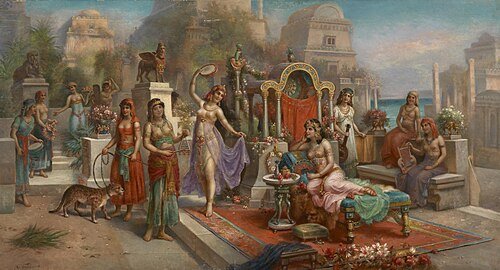
This is where things get interesting. According to one popular tradition, the gardens were constructed by King Nebuchadnezzar II, who ruled the Neo-Babylonian Empire from approximately 605 to 562 BC.
One ancient story claims that Nebuchadnezzar built the gardens for his wife, Amytis. She supposedly came from a greener and more mountainous region and missed the landscape of her homeland after marrying the Babylonian king.
The gardens were therefore supposedly created to remind her of home.
It is a romantic story, but there is a problem: historians have not found Babylonian records confirming that Nebuchadnezzar built the gardens for Amytis.
Why Haven’t Archaeologists Found Them?
The biggest mystery surrounding the Hanging Gardens is that Babylon has actually been extensively excavated. Archaeologists have uncovered enormous structures, temples, walls, palaces, and other remains from the ancient city.
Yet no structure has been conclusively identified as the Hanging Gardens.
This is particularly strange because the gardens would have been an enormous construction project. A complex capable of supporting large trees and transporting huge amounts of water should theoretically have left substantial archaeological evidence.
Instead, the evidence remains frustratingly absent.
Ancient Writers Described the Gardens
The lack of archaeological evidence does not mean that the gardens were completely invented in modern times. Several ancient writers described them, and their accounts helped establish the gardens as one of the wonders of the ancient world.
Greek and Roman writers including Diodorus Siculus, Quintus Curtius Rufus, and Strabo wrote about an extraordinary garden in Babylon.
Diodorus described enormous terraces supported by stone structures and trees of considerable size. Strabo also wrote about gardens that were supposedly watered using mechanical devices.
The problem is that these writers lived centuries after Nebuchadnezzar II. None of them appears to have personally witnessed the gardens during the time they supposedly existed.
The Hanging Gardens May Not Have Been in Babylon
One of the most fascinating theories is that the Hanging Gardens were real but were built somewhere else.
In the 20th century, British archaeologist Stephanie Dalley proposed that the gardens traditionally attributed to Babylon may actually have been constructed in Nineveh, the capital of the Assyrian Empire.
Dalley connected the gardens with the Assyrian king Sennacherib, who ruled during the 7th century BC. Sennacherib left inscriptions describing an impressive garden and an elaborate water-raising system.
He even described his garden in terms that sound remarkably similar to the later accounts of the Hanging Gardens.
If Dalley’s theory is correct, the famous gardens may have existed but were simply attributed to the wrong city.
Sennacherib May Have Built an Ancient Engineering Marvel
The Assyrians were remarkably advanced engineers, particularly when it came to moving water. Sennacherib constructed a huge canal system to bring water to Nineveh from the surrounding region.
One part of the system included an enormous stone aqueduct at Jerwan, which remains one of the oldest known aqueducts in the world.
Sennacherib also described a device that could raise water to higher levels. Some researchers believe it may have been an early form of the Archimedes screw, although whether that specific technology was actually used remains debated.
If the gardens were at Nineveh, this sophisticated irrigation system could have allowed trees and plants to flourish high above the ground.
Babylon Had Plenty of Gardens Anyway
Another reason the mystery is difficult to solve is that Babylon was not simply a barren desert city.
The ancient Babylonians were skilled farmers and irrigation experts. The region around Babylon was supported by the Tigris and Euphrates rivers, and extensive irrigation networks allowed people to grow crops in an otherwise challenging environment.
Babylonian palaces and temples also contained gardens. Therefore, gardens certainly existed in ancient Babylon. The question is whether there was one enormous, spectacular structure that deserved to be remembered as one of the Seven Wonders.
Could the Gardens Have Been Destroyed Completely?
It is possible that the gardens existed and were eventually destroyed. Babylon experienced wars, political upheaval, neglect, and environmental changes over the centuries.
Buildings constructed from mud brick, which was common in ancient Mesopotamia, could deteriorate significantly over time. Even structures made with stone could be dismantled and reused by later civilizations.
However, this explanation does not completely solve the mystery. Archaeologists have found extensive remains from Babylon, including structures dating to the reign of Nebuchadnezzar II. The absence of definitive evidence for the gardens therefore remains puzzling.