

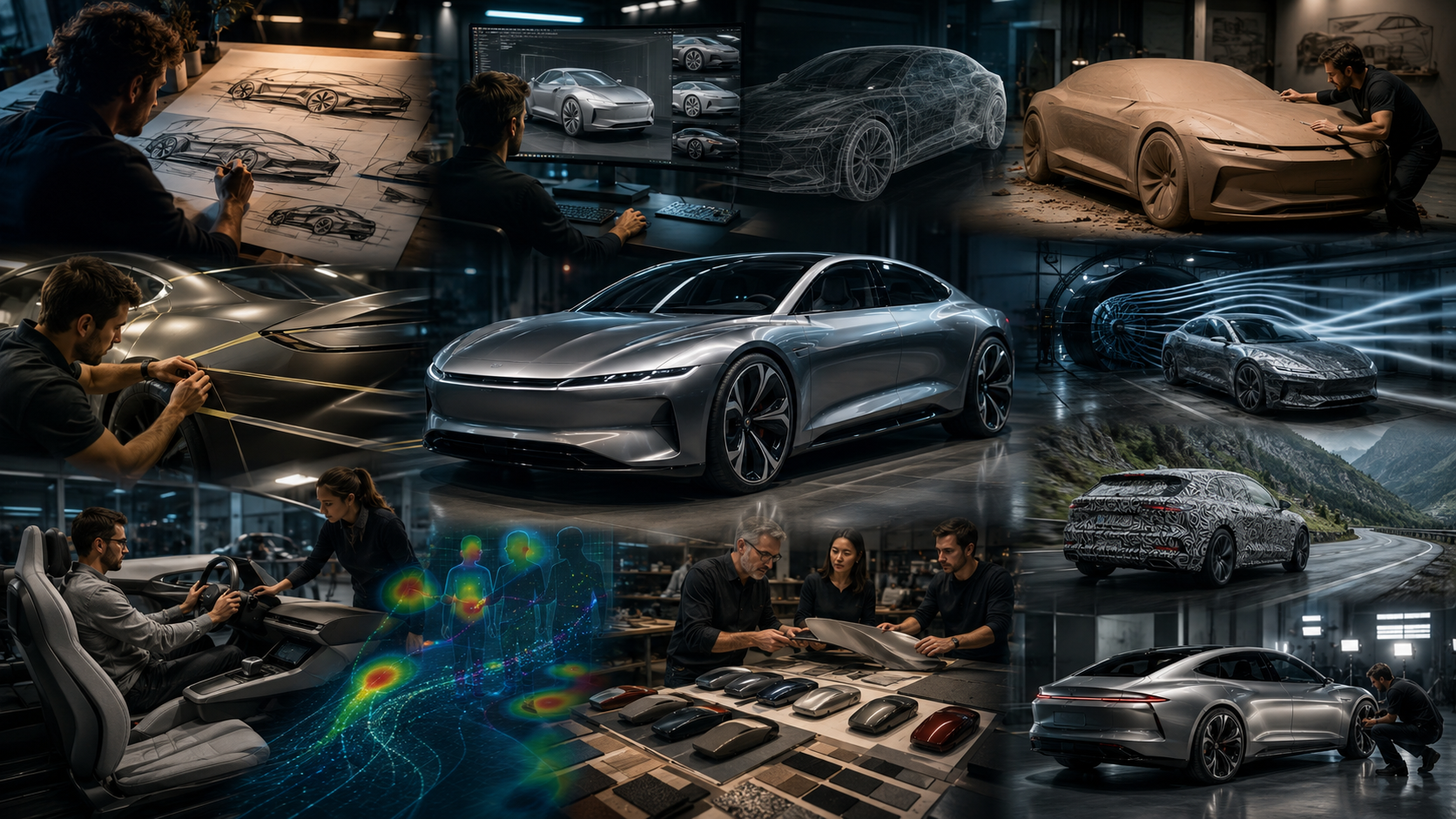

Most people imagine car design as a relatively linear process: designers sketch a concept, engineers build it, and the final vehicle appears largely as intended. In reality, modern automotive design is far more iterative, data-driven, and constrained by physical and digital systems than most drivers realise.
Behind every production car is a long chain of decisions shaped by aerodynamics, regulations, manufacturing limits, user behaviour data, and increasingly, software modelling. What reaches the road is often a carefully negotiated outcome rather than a pure creative vision.
Here are ten surprising facts that reveal how cars are actually designed.
1. Most Designs Begin Long Before Any Sketch Is Finalised
While sketches and concept drawings are the most visible part of car design, much of the early work happens before any styling is committed to paper.
Market analysis, packaging constraints, platform engineering, and regulatory requirements often define the boundaries of what a car can be before designers begin shaping its appearance.
In many cases, designers are working inside a pre-defined “hard point” structure that dictates wheelbase, cabin placement, and mechanical layout.
2. Clay Modelling Is Still a Critical Step
Despite advances in digital design tools, physical clay modelling remains a core part of automotive development.
Full-scale clay models allow designers and engineers to evaluate proportions, lighting reflections, and surface curvature in a way that screens still cannot fully replicate.
These models are continuously reshaped, sometimes daily, as feedback is incorporated from multiple departments.
3. Aerodynamics Often Overrides Aesthetic Intent
One of the most common compromises in car design happens in wind tunnels.
Even when a design looks complete from a styling perspective, aerodynamic testing can require significant changes—adjusting rooflines, reshaping mirrors, or modifying bumper geometry.
These changes are not purely about efficiency. They also influence stability, noise levels, and high-speed performance.
4. Interior Design Is Driven by Human Behaviour Data
Modern interiors are increasingly shaped by data collected from real users.
Manufacturers analyse how drivers interact with controls, how often certain features are used, and which touchpoints cause confusion or distraction.
This data directly influences button placement, screen layout, and even the angle of physical controls.
In some cases, designs are altered not because they look better, but because they reduce cognitive load while driving.
5. Regulations Shape More Design Decisions Than Aesthetics Do
Safety and emissions regulations play a major role in determining what a car can look like.
Pedestrian impact rules influence bonnet height and front-end shape. Lighting regulations affect headlight design. Emissions standards indirectly shape weight, materials, and aerodynamic efficiency.
Designers often describe regulation as one of the strongest “invisible forces” in automotive styling.
6. Digital Simulations Now Replace Many Physical Prototypes
Before a physical prototype is built, most modern cars exist extensively in digital form.
These simulations test everything from crash safety to airflow and suspension behaviour. Engineers can iterate rapidly without the cost of building physical components.
This has significantly reduced development time while increasing the number of design variations explored before final production.
7. Colour and Trim Decisions Are More Complex Than They Appear
Exterior paint and interior trim selection is a highly analytical process.
Manufacturers test colour performance under different lighting conditions, climates, and aging scenarios. They also analyse consumer psychology and regional preferences.
A single paint colour may go through dozens of iterations before it reaches production.
8. User Feedback From Previous Models Shapes Future Cars
Modern car design is increasingly evolutionary rather than revolutionary.
Data collected from previous models—service reports, user complaints, and feature usage statistics—feeds directly into the next generation of vehicles.
If a particular interface element is frequently misunderstood or underused, it is often redesigned or removed entirely.
9. Simulators Influence Design More Than Ever Before
High-fidelity driving simulators are now used not only for performance testing but also for design validation.
Engineers and designers can experience how a vehicle feels before it physically exists, allowing them to adjust seating position, visibility, and control layout in virtual environments.
This has made subjective driving experience a measurable part of the design process.
10. Even Small Identity Elements Are Carefully Considered
While major design decisions focus on performance, safety, and usability, smaller elements of vehicle identity are also carefully evaluated.
Details such as badging placement, surface finishes, and visual symmetry contribute to how a vehicle is perceived both on the road and in media presentation.
Within this broader ecosystem of identity and presentation, automotive culture extends beyond design studios. Even elements such as registration presentation sit within the wider context of how drivers express individuality. In that space, companies such as Plates Express exist as part of the wider landscape of automotive identity, where design and personal expression intersect.
Conclusion
Car design is far more complex than most people realise. It is a balancing act between creativity, engineering, regulation, data, and human behaviour.
What appears on the road is not simply a designer’s vision, but the result of thousands of decisions made across multiple disciplines and systems.
Understanding this process reveals something important: modern cars are not just designed for aesthetics or performance alone, but for how humans actually behave, interact, and respond in real-world conditions.
In that sense, every vehicle is less a finished object and more a carefully engineered compromise between intention and reality.