

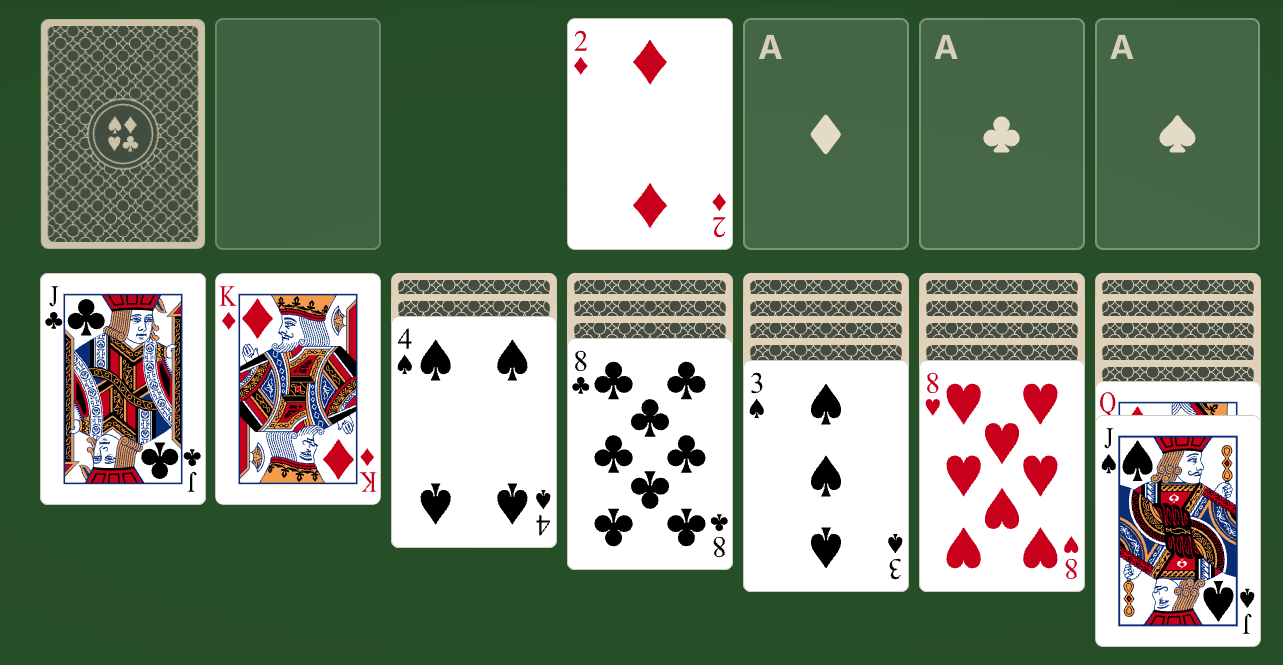

Solitaire looks almost too familiar to have secrets. A deck, seven columns and four foundation piles can feel like part of the furniture of modern life. Yet the game has crossed centuries, languages and technologies while keeping its basic appeal. Today, a player can open PlaySolitaire in a browser and begin within seconds, but that simple experience carries a much longer story about cards, probability, design and the rise of personal computing.
1. Solitaire Is a Family of Games, Not One Game
The word solitaire describes a broad family of games designed mainly for one player. Klondike is the version most people picture, but Spider, FreeCell, Pyramid and Golf use very different layouts and goals. This helps explain why two people can both say they play solitaire while following completely different rules. The shared idea is not one fixed layout. It is the challenge of creating order from a shuffled set of cards.
2. The Same Game Has Two Familiar Names
In North America, the usual name is solitaire. In Britain and several other countries, many people call the same category of games patience. Both names describe something essential. Solitaire points to playing alone, while patience describes the calm, repeated attention often needed to solve a difficult deal. The different names also show how widely the game spread before computers made one version globally recognizable.
3. Klondike Became the Default Version
Klondike is only one member of the solitaire family, yet it became the standard image of the game. Its layout is instantly recognizable: seven tableau columns, cards that build downward in alternating colors and four foundations that build upward by suit. The balance of visible cards and hidden information gives each deal a clear objective without making the solution obvious.
4. Windows Turned Solitaire Into a Computer Habit
Microsoft included Windows Solitaire with Windows 3.0 in 1990. That decision placed a familiar card game on millions of personal computers. It also connected leisure with a new everyday tool. People who might never have bought a computer game found Solitaire waiting on the machine they used for work, study or home administration.
5. The Game Quietly Taught Mouse Skills
Microsoft has explained that Windows Solitaire helped users practice dragging and dropping objects with a mouse, a skill that was still unfamiliar to many people in 1990. Moving a card from one pile to another provided immediate visual feedback. A player learned how to point, click and drag without reading a technical manual. In that sense, Solitaire was also a friendly lesson in graphical computing.
6. A Deck Can Be Shuffled in an Astronomical Number of Ways
A standard deck of 52 distinct cards can be arranged in 52 factorial possible orders. That number is roughly 8 followed by 67 zeros. Not every arrangement produces a unique Klondike experience, because the rules determine how cards are dealt and revealed, but the scale still explains why the game rarely feels exhausted. Even a simple deck creates more possible starting orders than anyone could play in a lifetime.
7. Not Every Deal Offers the Same Chance
Solitaire is not simply a test of skill. Hidden cards and the initial shuffle can create deals that are far easier or harder than others. Some rule sets also allow more passes through the stock than others. This is why a loss does not always mean that the player made an obvious mistake. The puzzle is partly strategic and partly shaped by information that is unavailable at the start.
8. Small Rule Changes Create New Games
Changing one detail can transform the experience. Drawing one card instead of three makes Klondike more forgiving. Allowing unlimited passes through the stock changes the value of planning. Spider asks players to build complete suited sequences, while FreeCell makes almost every card visible from the beginning. Solitaire has lasted partly because its core idea is flexible enough to support many kinds of puzzles.
9. Its Popularity Is Truly Global
For the thirtieth anniversary of Microsoft Solitaire in 2020, Xbox reported more than 35 million monthly players across more than 200 countries and territories, with over 100 million hands played each day. Those figures cover only Microsoft’s collection, not every physical deck, app or browser version. They reveal how a quiet solo card game became one of the most widely shared forms of digital play.
10. The Browser Returned Solitaire to Its Portable Roots
Long before computers, solitaire needed only a deck and a flat surface. Browser versions restore that same sense of availability in a modern form. There is no box to find, program to install or opponent to organize. The technology has changed, but the attraction remains remarkably consistent: a clear puzzle, a familiar rhythm and the possibility that the next deal will unfold differently.
That combination of simplicity and depth is why Solitaire has survived every major shift in personal technology. It moved from cards to desktop computers, then to phones and browsers, without losing the basic pleasure of turning disorder into a clean sequence.