


02. Pompeii
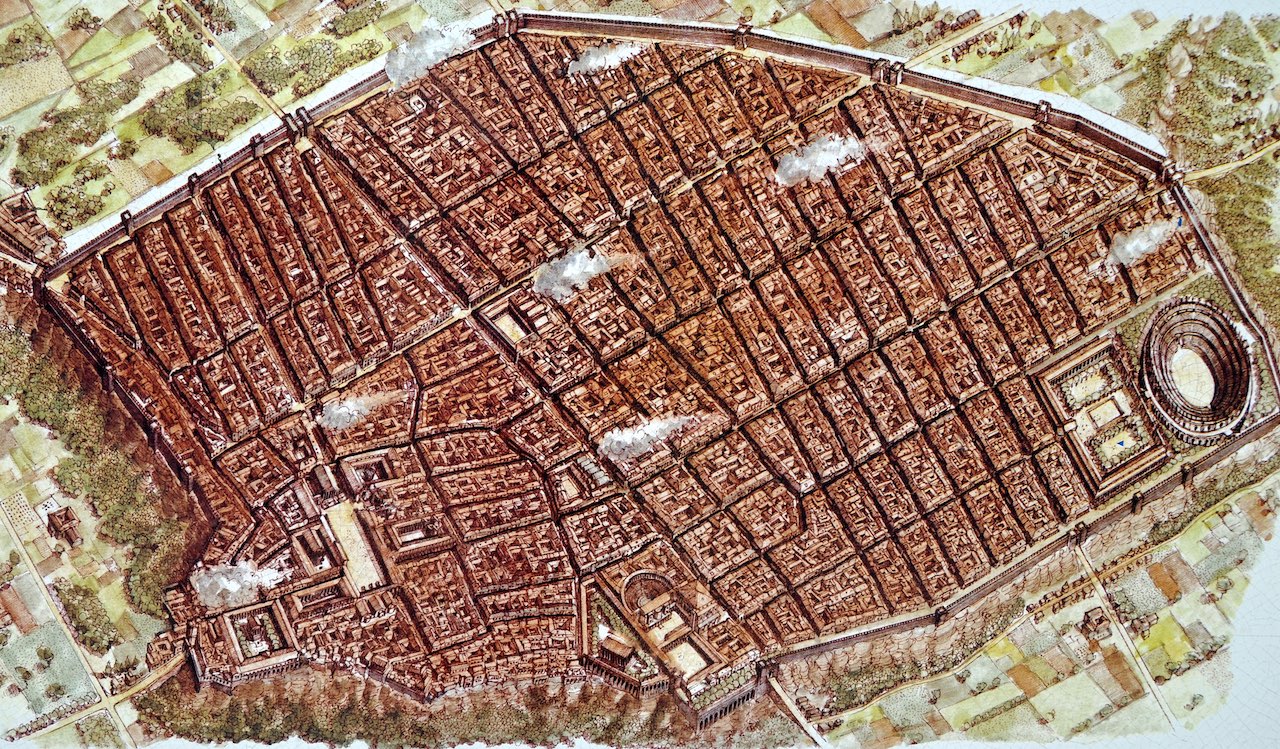
Click for higher resolution
An accurate view of ancient Pompeii before it was destroyed by an eruption in 79 A.D.
Pompeii was an ancient Roman town-city near modern Naples, in the Campania region of Italy, in the territory of the comune of Pompei. Pompeii, along with Herculaneum and many villas in the surrounding area, was mostly destroyed and buried under 4 to 6 m (13 to 20 ft) of volcanic ash and pumice in the eruption of Mount Vesuvius in AD 79.
Researchers believe that the town was founded in the seventh or sixth century BC by the Osci or Oscans. It came under the domination of Rome in the 4th century BC and was conquered and became a Roman colony in 80 BC after it joined an unsuccessful rebellion against the Roman Republic. By the time of its destruction, 160 years later, its population was estimated at 11,000 people, and the city had a complex water system, an amphitheater, gymnasium, and a port.
Public and private toilets were sprinkled throughout the city of Pompeii. But despite the city’s sewer infrastructure, virtually none of these toilets had sewer connections. We have similar evidence for ancient Herculaneum. In fact, almost every private house in these cities, and many apartment houses in Ostia had private, usually one-seater, toilets not connected to the main sewer lines.
And these cesspit toilets were often situated in the kitchen, where food was prepared! The comforting smells from a hearty stew would have mingled with the gross odors from the nearby open cesspit. Collected waste was either sold to farmers for fertilizer or used in household gardens – which must have made for some pretty stinky garden parties from time to time. One reason may be tied to that fact that Roman sewer openings had no traps. One never could be sure what might climb out of an open sewer pipe and into your house.
We have at least one dramatic ancient story that illustrates the danger of hooking your house up to a public sewer in the first or second century AD. The author Aelian tells us about a wealthy Iberian merchant in the city of Puteoli; every night a giant octopus swam into the sewer from the sea and proceeded up through the house drain in the toilet to eat all the pickled fish stored in his well-stocked pantry.
Even public latrines – multi-seater toilets that were almost always connected to the main sewer lines of a city – posed serious threats to users. Don’t be fooled by the clean white marble and open-air sunniness of the reconstructed ruins we can see today; most Roman public toilets were dark, dank and dirty, and often situated in small spaces. Those who could “hold it” long enough to return to their own houses with their own cesspit toilets certainly would have done so.
Even worse, these public latrines were notorious for terrifying customers when flames exploded from their seat openings. These were caused by gas explosions of hydrogen sulfide (H2S) and methane (CH4) that were rank as well as frightening. Customers also had to worry about rats and other small vermin threatening to bite their bottoms. And then there was the perceived threat of demons that the Romans believed inhabited these black holes leading to the mysterious underbelly of the city.
One late Roman writer tells a particularly exciting story about such a demon. A certain Dexianos was sitting on the privy in the middle of the night, the text tells us, when a demon raised itself in front of him with savage ferocity. As soon as Dexianos saw the “hellish and insane” demon, he “became stunned, seized with fear and trembling, and covered with sweat.” Such superstition would provide another good reason for avoiding sewer connections in private house toilets.
Going to a public toilet was definitely a dangerous business, so it is no wonder that the Goddess Fortuna often appears as a kind of “guardian angel” on the walls of toilets. We don’t tend to put religious shrines in our toilets, but we find them again and again in both public and private toilets in the Roman world.
One graffito on a side street in Pompeii directs a warning at a toilet-user himself: “Crapper Beware the Evil”… of crapping on the street? Of putting your bare bottom on an open toilet hole for fear of biting demons? Of the ill health, you will feel if you do not move your bowels well? We’ll never know for sure, but these are likely possibilities, I think.
The eruption destroyed the city, killing its inhabitants and burying it under tons of ash. Evidence for the destruction originally came from a surviving letter by Pliny the Younger, who saw the eruption from a distance and described the death of his uncle Pliny the Elder, an admiral of the Roman fleet, who tried to rescue citizens. The site was lost for about 1,500 years until its initial rediscovery in 1599 and broader rediscovery almost 150 years later by Spanish engineer Rocque Joaquin de Alcubierre in 1748. The objects that lay beneath the city have been preserved for centuries because of the lack of air and moisture. These artifacts provide an extraordinarily detailed insight into the life of a city during the Pax Romana. During the excavation, plaster was used to fill in the voids in the ash layers that once held human bodies. This allowed archaeologists to see the exact position the person was in when he or she died.
Hey,
Thanks for using my Global population density heatmap. Could you please show the source? https://www.etsy.com/ca/listing/483624707/global-population-density-heatmap-high
Thanks,
Robert
Done.